
Boosting Bolt Action Rifle Performance: Key Tips and Techniques
Mar 27th 2026
A precision bolt action rifle works best when every part works together. Accuracy comes from strong engineering, tight tolerances, and careful setup. When these elements line up, a rifle can deliver repeatable performance and reliable sub-MOA accuracy. Many shooters look for ways to improve bolt action accuracy. The truth is that most gains come from understanding the mechanical parts of the rifle. The receiver, barrel, bedding, trigger, and recoil system all play a role.
1934 Armory focuses on the most important piece of that system: the action. We manufacture precision bolt action receiver systems and components for serious shooters, producing the high-tolerance parts that serve as the foundation of precision builds.
Why Receiver Quality Matters Most
Every precision bolt action rifle begins with the receiver. The receiver controls how the bolt locks, how the cartridge lines up with the barrel, and how smoothly the action cycles. When tolerances are tight and alignment is correct, the rifle can produce consistent groups. When the receiver is poorly machined, even the best barrel and optics struggle to compensate that performance gap. That is why the best builds start by selecting a high-quality custom rifle action.
Truing, Tolerances, and the Remington 700 Footprint
One common step in precision rifle work is action truing. This process ensures the receiver face, bolt lugs, and barrel threads all align perfectly. When these surfaces are square and centered, the bolt locks up evenly each time you fire a shot. That consistency helps the rifle produce repeatable tighter groups.
Many custom builds use a Remington 700 footprint, as this pattern is widely supported and allows compatibility with many stocks, triggers, and accessories available on the market today. Using a high-tolerance receiver from the start often reduces the amount of truing work required. This saves time for gunsmiths and improves reliability for shooters.
Bolt Lug Contact and Lock-Up Consistency
Another key factor in rifle accuracy is bolt lug engagement. The locking lugs must contact the receiver evenly when the bolt locks closed. If the contact is uneven, the bolt can shift slightly when firing. That movement changes how the cartridge sits in the chamber.
Good bolt lock-up improves upon two major factors to accurate shooting; it keeps the cartridge consistently aligned with the barrel and maintains chamber pressure. Together, these factors help a rifle produce reliable groupings. High-quality precision bolt action components are designed with lug alignment and lock-up in mind from the beginning.
Bedding, Chassis, and Stock: Securing Your Foundation
The action and barrel must sit firmly in the rifle’s stock or chassis. If movement occurs during recoil, accuracy suffers on target. Proper bedding keeps the receiver stable and ensures the rifle’s barrel returns to the same position after each shot. Two common approaches exist for this step: traditional bedding and modern chassis systems.
Pillar Bedding vs. Modern Chassis Systems
Pillar bedding and chassis system setups both aim to stabilize the action. Pillar bedding uses metal pillars inside the stock. These pillars prevent the action screws from compressing the stock material. This keeps torque consistent and maintains proper alignment. Many traditional precision rifles use pillar bedding because it creates a strong, stable connection between the action and stock.
Modern custom rifles often use aluminum chassis systems instead. A chassis holds the receiver inside a rigid metal frame. This system offers strong structural support with adjustable ergonomics and incorporated options to easily mount accessories.
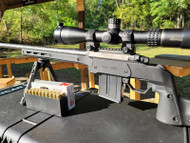
Shooters often pair a precision action with a premium short-action chassis to create a modular rifle system. Both methods can produce excellent results. The key is maintaining a stable connection between the receiver and the rest of the rifle.
Free-Floating Your Barrel for Repeatable Accuracy
Barrel contact can also affect accuracy. When a stock presses against the barrel, small changes in pressure can shift the point of impact. You may also hear people talk about barrel harmonics, which are the vibrations of the barrel when a shot is fired. A free-floating barrel solves this problem. The barrel sits slightly above the stock or chassis and does not come into contact with the support system.
Free-floating helps maintain consistent match-grade barrel harmonics, or how the barrel vibrates when a shot is fired. When the barrel vibrates the same way each time, the rifle produces more predictable and repeatable groups. Free-floating the barrel is one of the most common and effective ways to improve bolt action accuracy.
Trigger and Muzzle Brake: Fine-Tuning the Details
Once the action, bedding, and barrel are set up correctly, smaller upgrades can refine your rifle’s performance. Two areas that affect shooter control are the trigger and the recoil system. A good trigger improves shot timing. Triggers should have a consistent trigger pull weight and creep. Creep refers to the small movement you feel before the trigger breaks. A clean trigger break helps shooters fire without disturbing the rifle’s position.
Another factor in rifle performance is recoil management. Many precision rifles use brakes designed for recoil reduction. A muzzle brake directs gas sideways as the bullet exits the barrel, reducing recoil and muzzle movement. When a rifle is intentionally built to eliminate the negative factors of recoil, shooters are able to stay on target after firing, spotting impacts and firing follow-up shots quicker. These upgrades may seem small, but they can significantly improve control during long-range shooting.
Putting It All Together: Building a Performance-Driven Bolt Gun
Improving rifle performance is not about a single part. It comes from combining high-quality bolt action rifle parts with proper setup. A typical performance rifle requires a precision bolt-action receiver, a match-grade barrel and consistent trigger, a recoil reducing muzzle device, and a proper bedding or chassis system. When these elements work together, the rifle becomes stable, predictable, and accurate.
The heart of this entire system is a custom bolt action. For competitive shooters and serious hunters, a well-machined action forms the core of a reliable system. 1934 Armory focuses on that foundation. Founded in 2023 by Bert Elsner in Hanover, Pennsylvania, the company blends traditional firearms knowledge with advanced machining. We manufacture precision actions, bolts, and accessories designed for demanding builds. Our premium bolt action receivers provide the structural base for many custom rifles.
You can explore additional parts such as the PRO Chassis system and accessories designed to complement precision builds. Precision shooting always begins with the right foundation. Tight tolerances, proper bedding, and reliable components all work together to improve accuracy. If you are planning a new build or sourcing high-tolerance components for custom rifles, the first step is choosing a well-designed action.